SUITABLY QUALIFIED
PERSONS TRAINING
__
ONLINE TRAINING FOR THE WASTE AND
RECYCLING INDUSTRY
Our online training courses
are written by industry experts
__
Waste industry news
Our courses are updated regularly to
provide the most up-to-date and
compliant waste management
education in Victoria
Crossing the Divide: Why Online Training is Victoria’s Best Tool for Environmental Compliance
|
Scaling the “State of Knowledge”Under Victorian law, your “State of Knowledge” is determined by what is reasonably known about a risk. If the EPA releases new guidance on managing construction dust or liquid waste, that knowledge must permeate your entire organization immediately. In a traditional model, this would require a “roadshow” of trainers traveling thousands of kilometers. By the time the trainer reaches the final site, the information might already be weeks old. Online training collapses geography. It allows an organization to push critical regulatory updates to every employee across the state simultaneously. This ensures that a “reasonably practicable” standard is met consistently, whether the site is five minutes from the head office or five hours. |
Eliminating the “Compliance Gap” in Regional Areas |
|
Geographically isolated sites often suffer from a “compliance gap”—the delay between a new hire starting and their first formal face-to-face training session. In the context of the EPA, this gap is a period of high risk. An untrained worker on a remote site is a “notifiable incident” waiting to happen. Online training provides On-Demand Induction. A new employee in Wodonga can complete their environmental risk modules on day one, hour one.
The “Green” Benefit: Walking the EPA TalkThere is a poetic irony in driving a fleet of diesel vehicles across Victoria to teach a course on carbon footprint reduction. The EPA encourages businesses to look at their holistic impact on the environment. By shifting to online training, Victorian businesses significantly reduce their Scope 3 emissions (indirect emissions from business travel). |
|
Feature |
In-Person (Regional) |
Online Learning |
|
Travel Time |
4–10 hours per session |
Zero |
|
Carbon Footprint |
High (Fuel/Transport) |
Low (Data/Server) |
|
Cost |
High (Flights/Hotels/Venues) |
Low (Subscription/Platform) |
|
Scalability |
Limited by room size |
Unlimited |
For a company managing multiple sites across the state, the cumulative reduction in fuel consumption and vehicle wear-and-tear isn’t just a cost saving—it’s a tangible environmental win that aligns with the spirit of the Act.
Precision Tracking for Legal Protection |
As discussed in the context of management liability, if you can’t prove you trained them, you didn’t train them. In a geographically dispersed workforce, keeping track of paper sign-in sheets from 20 different sites is an administrative nightmare.
Online platforms offer Automated Governance.
- Centralized Dashboards: Management can see at a glance who in Ballarat is overdue for their “Waste Duties” refresher.
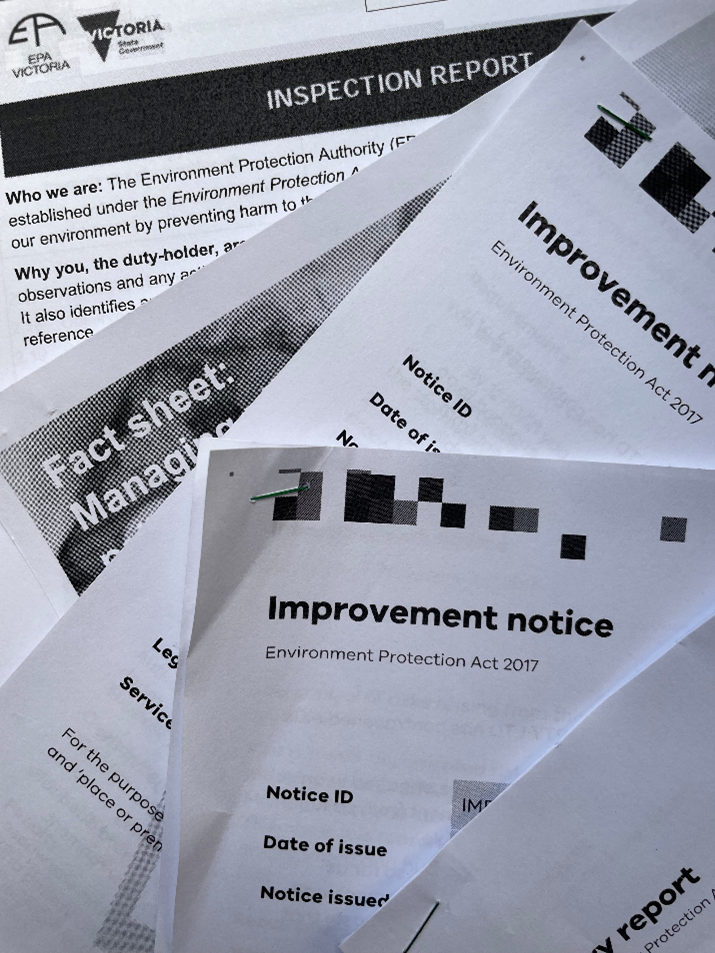
- Audit Readiness: If an EPA officer visits a remote site, the worker can pull up their digital training certificate on a smartphone. This instant proof of competency is invaluable during a site inspection and demonstrates a “culture of compliance” to the regulator.
Catering to the Modern Victorian Workforce
Victoria’s workforce is increasingly mobile. Employees move between sites and often work irregular hours. Online training respects this flexibility. It allows a worker to engage with the material when they are most alert, rather than at the end of a grueling four-hour commute to a training center. Interactive elements—videos, quizzes, and simulations—ensure that the learner is actually absorbing the material, not just nodding off in the back of a conference room.
The Verdict: Distance is No Longer an Excuse
In the eyes of the Victorian EPA, distance does not dilute duty. A failure to educate a worker in Ouyen is just as serious as a failure in Port Melbourne.
Online training removes the barriers of time, cost, and kilometers. It allows Victorian businesses to build a “borderless” safety culture where environmental protection is a shared language.