
SUITABLY QUALIFIED
PERSONS TRAINING
__
ONLINE TRAINING FOR THE WASTE AND
RECYCLING INDUSTRY
Our online training courses
are written by industry experts
__
Waste industry news
Our courses are updated regularly to
provide the most up-to-date and
compliant waste management
education in Victoria
The Silent Guard: Why Training is the Ultimate Defence in Victoria’s New EPA Landscape |
By Andrew Swann
|
In the busy landscape of Victorian industry, “compliance” is often viewed as a box to be checked—a set of forms to be filed and a permit to be hung on the wall. However, since the introduction of the Environment Protection Act 2017, the goalposts have shifted. We have moved from a system of “wait for a permit” to a proactive era defined by the General Environmental Duty (GED). Under this new regime, the burden of proof has reversed. It is no longer enough to say you didn’t mean to cause harm; you must prove you took every “reasonably practicable” step to prevent it. At the heart of this proof lies one often-overlooked tool: Training. |
The GED: More Than Just a Legal ClauseThe General Environmental Duty is the cornerstone of Victoria’s environmental laws. It states that anyone engaging in an activity that poses a risk to human health or the environment from pollution or waste must minimize those risks. |
But here is the catch for management: Section 25(4)(e) of the Act explicitly requires duty holders to provide “information, instruction, supervision, and training” to anyone engaged in the activity.
In the eyes of the EPA, if your staff aren’t trained, you haven’t met your duty. Training is no longer a “nice to have”—it is a legislative mandate.
Training as Environmental Protection |
Environmental disasters rarely happen because of a single catastrophic mechanical failure. They happen because a technician didn’t know the secondary containment valve was open, or a site manager didn’t recognize the signs of a slow leak into the stormwater drain.
Training transforms your workforce from a liability into a detection network. When employees understand the “why” behind environmental controls, they become the first line of defence. They move beyond following a checklist to understanding the State of Knowledge—a key legal term that refers to what a person should reasonably know about risks and how to manage them.
- Hazard Identification: Trained eyes spot “near-misses” before they become EPA “notifiable incidents.”
- Response Agility: When a spill occurs, a trained team acts in seconds, not minutes, potentially saving the company millions in cleanup costs and habitat restoration.
Protecting Management: The “Failure to Educate” Trap
For directors and managers, the risk of “failing to educate” is personal. The Victorian EPA has moved toward a model of officer liability. If a company breaches its duties, the EPA can look upward to see if the leadership exercised “due diligence.”
If an incident occurs and the investigation reveals that employees were never given formal induction or refresher training on environmental risks, management’s defence effectively vanishes.
The Reality Check: A lack of training is seen as a management failure. It suggests a culture of negligence, making it far easier for the EPA to pursue criminal or civil penalties against the corporation and its officers.
The “Reasonably Practicable” Standard
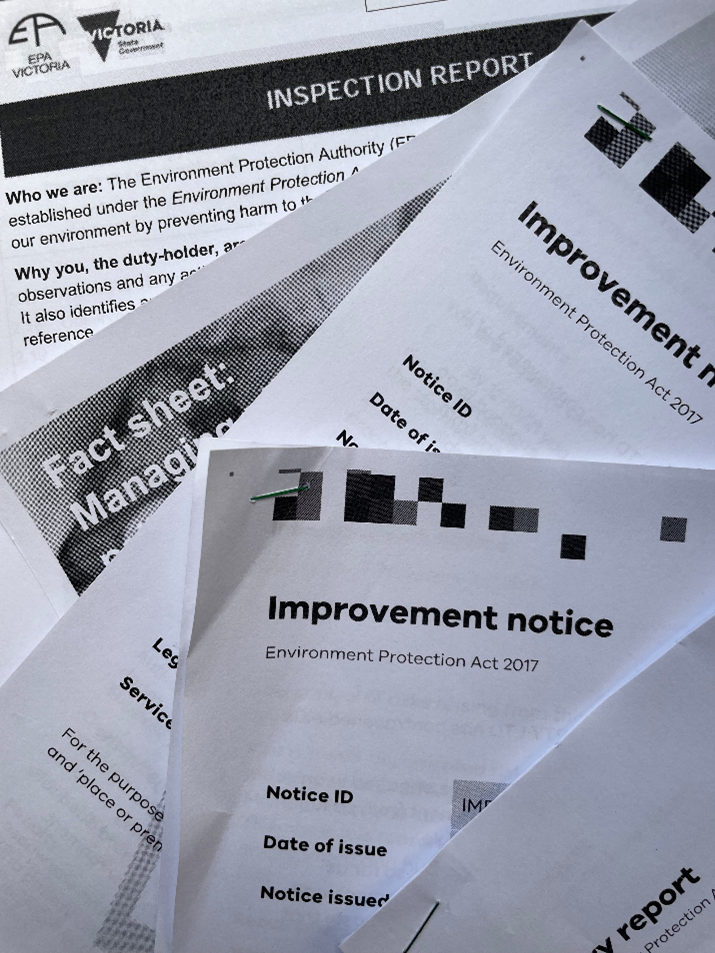
When an EPA inspector visits your site, they aren’t just looking at your equipment; they are looking at your Risk Management and Monitoring Program (RMMP). They will ask to see your Training Register.
To satisfy the “reasonably practicable” test, management must demonstrate that they provided training proportionate to the risk. High-risk activities (like chemical handling) require intensive, competency-based training. Low-risk activities might only require basic induction. Failing to scale your education to the risk level is a frequent point of failure during EPA audits.
Moving Beyond the Classroom
True environmental training in the Victorian context isn’t a one-hour PowerPoint presentation once a year. To protect the environment and management, training must be:
Conclusion: An Investment, Not an ExpenseIn Victoria, the cost of training is a fraction of the cost of a single EPA fine, which can reach into the millions for corporations. More importantly, a trained workforce fosters a culture of stewardship. When people are educated, they don’t just protect the company; they protect the air, water, and soil of the communities they live in. Protecting the environment starts with the mind of the person on the tools. If you haven’t educated them, you haven’t protected your business. |